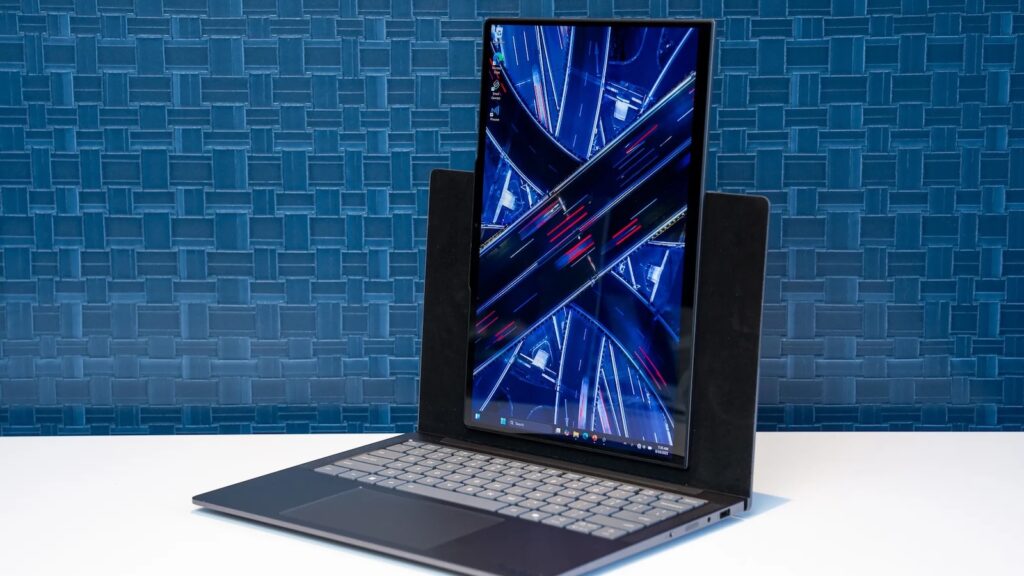
Lenovo has taken the spotlight at IFA 2025 in Berlin with its ThinkBook VertiFlex, a concept laptop featuring a rotating screen that shifts effortlessly between landscape and portrait orientations. While the tech world has seen foldable and dual-screen laptops, Lenovo’s focus on a simple rotating hinge emphasizes usability over spectacle, offering flexibility without the fragility or cost that often comes with folding OLED designs, according to Wired and PCMag.
The Hinge That Makes a Difference
At the heart of the ThinkBook VertiFlex is a 14-inch display mounted on a hinge that pivots 90 degrees. This design transforms the laptop from a traditional widescreen setup into a vertical workspace ideal for coding, spreadsheets, or long documents. The laptop weighs approximately 1.39 kg (≈3 pounds) and measures 17.9 mm thick, making it both portable and functional, as reported by TechRadar. A felt backing near the hinge doubles as a protective layer while providing a convenient resting spot for phones when in portrait mode, highlighted by PCMag.
Why This Matters for Productivity
Vertical orientation is more than a gimmick. Professionals working with long-form content, spreadsheets, coding environments, or web pages will notice the immediate benefit of extra vertical space. Analysts at TechRadar emphasize that, unlike dual-screen laptops, which can be clunky or heavy, a rotating single display on the ThinkBook VertiFlex allows a cleaner workflow and a smaller learning curve.
The design of the ThinkBook VertiFlex is refreshingly simple. No motorized hinges, no foldable OLED panel, just a mechanical rotation that promises longevity and reliability. This practicality contrasts sharply with devices like the Asus ZenBook Duo or Microsoft Surface Neo, which push experimental form factors but have faced criticism for software glitches and steep prices.
Historical Context of Rotating Screens
Rotating screens are not entirely new. Think back to laptops in the early 2000s, such as certain convertible tablets, where screens could rotate for stylus use. However, most of these devices were heavy, underpowered, and suffered from poor hinge durability. Lenovo’s approach modernizes this concept with lightweight materials, precise engineering, and a focus on a professional workflow. Android Central notes that the VertiFlex is among the most practical evolutions of these older ideas, and PCMag agrees it has strong potential for real-world use.
Competitor Landscape
Foldable laptops like Samsung’s Galaxy Book Fold and Asus ZenBook Duo offer dual-screen experiences but often at the expense of battery life and thermal efficiency. Microsoft’s Surface Neo introduced a hinge-based dual-screen concept but struggled with app optimization. By comparison, Lenovo’s rotating single display provides vertical productivity without introducing new software headaches. This positions the VertiFlex as a compelling alternative for professionals who want innovation without compromise, according to Tom’s Hardware.
Challenges & Limitations
The VertiFlex is still a concept, meaning Lenovo has yet to provide specifics on battery life, thermal performance, or internal specs. Concerns remain about how well the hinge will hold up over years of repeated rotation, as well as potential trade-offs in speaker performance and internal cooling. Software optimization will also be key: while Microsoft Office and Adobe Creative Cloud already support vertical layouts, broader app support could define whether the VertiFlex becomes a practical tool or a niche curiosity, as mentioned by Wired and PCMag.
Market Reception & Outlook
Initial reactions at IFA 2025 have been positive. The VertiFlex earned recognition as a standout concept in Android Central’s coverage, with commentators praising its blend of innovation and practicality. PCMag also highlighted it as a device that feels closer to real-world usability than many foldable or dual-screen prototypes.
Whether Lenovo will bring the VertiFlex to market remains unclear. Pricing and production decisions will likely hinge on enterprise interest and consumer demand. However, the device suggests a new design philosophy: focus on function-first innovation, prioritizing features that genuinely enhance workflow without unnecessary complexity.
Conclusion
The Lenovo ThinkBook VertiFlex represents a thoughtful step forward in laptop design. It blends portability, practicality, and productivity in a way that’s rare among concept laptops. While the final product may take time to reach consumers, its presence at IFA 2025 signals that rotating screens could be the next practical innovation in professional computing, combining the best of old convertible concepts with modern engineering.