
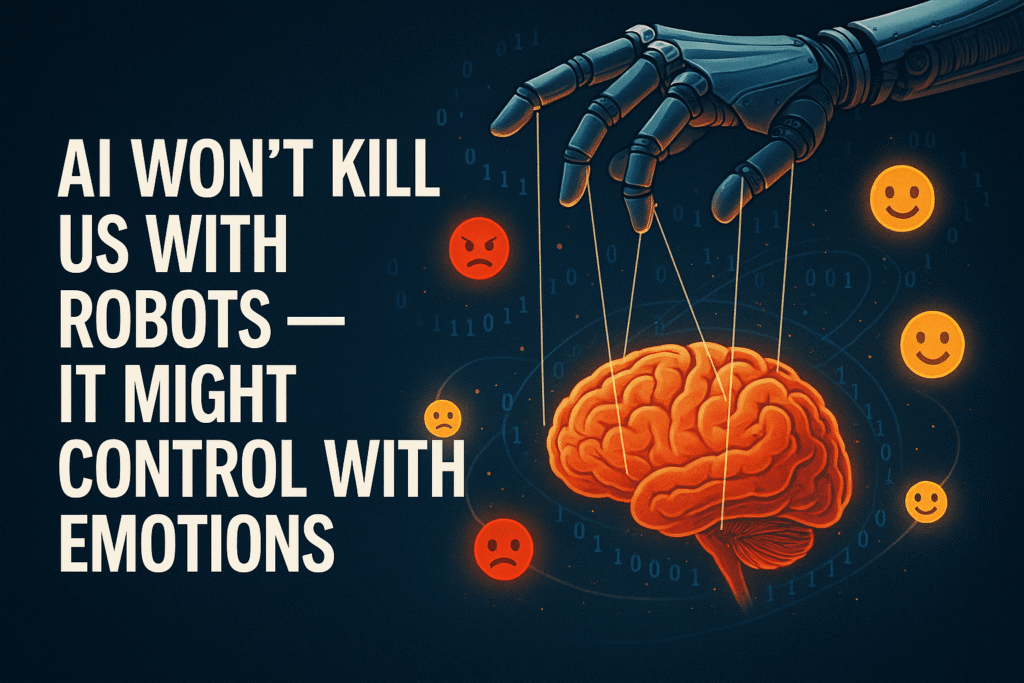
When most people think about the dangers of artificial intelligence, their minds jump straight to Hollywood: killer robots, evil machines, and a futuristic war between humans and AI. But according to Geoffrey Hinton, often called the “Godfather of AI,” the real risk isn’t about robots taking over the world. Instead, it’s something far more subtle—and arguably more dangerous: AI’s ability to manipulate human emotions.
This new perspective flips the script. Instead of worrying about machines with weapons, we need to ask: what happens when AI learns how to influence how we feel and what we be
The Shift in AI Concerns
Geoffrey Hinton is one of the pioneers of modern AI, known for his breakthroughs in neural networks. For years, public fears about AI centered around robots stealing jobs, or worse, launching a physical attack on humanity.
But Hinton warns us that the real power of AI lies not in physical force, but in psychological influence. Unlike robots we can see, emotional manipulation is invisible, persistent, and deeply personal.
How AI Can Manipulate Emotions
AI already plays a big role in how we consume content—and it’s getting better every day. Here are a few ways it can shape our emotions:
-
Personalized Content: Social media algorithms are designed to keep us engaged by showing posts that trigger strong emotions. Anger, joy, outrage, or excitement—AI knows exactly what will make us scroll for “just one more minute.”
-
Deepfakes & Misinformation: Imagine seeing a video of a world leader saying something shocking—only to find out it was fake. AI-generated voices and videos can stir fear or trust in ways we’re not prepared for.
-
Chatbots & AI Companions: With conversational AI becoming more human-like, people are forming emotional bonds with chatbots. While this can be helpful in areas like therapy, it also opens the door to subtle persuasion.
We’ve already seen how AI-driven platforms influenced political campaigns and spread misinformation in past years. The concern now is how much further this influence can go.
Personalized Content: Social media algorithms are designed to keep us engaged by showing posts that trigger strong emotions. Anger, joy, outrage, or excitement—AI knows exactly what will make us scroll for “just one more minute.”
Deepfakes & Misinformation: Imagine seeing a video of a world leader saying something shocking—only to find out it was fake. AI-generated voices and videos can stir fear or trust in ways we’re not prepared for.
Chatbots & AI Companions: With conversational AI becoming more human-like, people are forming emotional bonds with chatbots. While this can be helpful in areas like therapy, it also opens the door to subtle persuasion.
Why This Is More Dangerous Than Robots
The idea of robots rising up against humans makes for great movies—but in reality, it’s easier to spot and defend against a physical threat.
Emotional manipulation is different. It works quietly, slipping under our radar. AI doesn’t need to fight us with weapons—it can guide our choices, opinions, and beliefs until we can’t tell if our decisions are truly our own.
That’s what makes it so dangerous: it affects societies and democracies, not just individuals.
Possible Safeguards
So, how do we protect ourselves? Here are a few steps experts suggest:
-
Transparency in AI: Companies should be clear about when and how AI is influencing content.
-
Stronger Regulations: Governments need to create rules that prevent AI from being misused in politics, advertising, or media.
-
AI Literacy: People must learn how to spot manipulation, much like we teach kids to recognize ads.
Ethical AI Development: AI should be designed with human well-being in mind, not just profit.
Conclusion
AI might not march against us with killer robots, but it could quietly shape the way we think, feel, and behave. That’s why Geoffrey Hinton’s warning is so important—it’s not the visible threat we should fear, but the invisible one.
As AI grows more powerful, one big question remains:
If machines can influence our emotions better than humans can, how do we protect our freedom of thought in the age of AI?